



What is in this leaflet
This leaflet answers some common questions about CASPOFUNGIN AN. It does not contain all the available information.
It does not take the place of talking to your doctor or pharmacist.
All medicines have risks and benefits. Your doctor has weighed the risks of you using CASPOFUNGIN AN against the benefits they expect it will have for you.
If you have any concerns about being given this medicine, ask your doctor or pharmacist.
Keep this leaflet. You may need to read it again.
What CASPOFUNGIN AN is used for
CASPOFUNGIN AN is used to treat the following fungal infections:
- Invasive candidiasis, including candidaemia
- Oesophageal candidiasis
- Invasive aspergillosis, when other antifungal treatments have not worked or when other antifungal treatments have not been tolerated.
Also, your doctor may suspect that you have a fungal infection in the following situation, and prescribe CASPOFUNGIN AN to treat it.
- Chemotherapy or other medical treatments or conditions can lower the body's resistance to disease by lowering counts of certain white blood cells. If you have persistent fever following chemotherapy or under other conditions as noted above, and your fever is not reduced by treatment with an antibiotic, you may have a fungal infection.
Candidiasis is an infection caused by a fungus (yeast) called candida. Invasive candidiasis is a serious type of candidiasis which occurs in your bloodstream (referred to as candidaemia), or in tissues or organs such as the lining of the abdomen (peritonitis), the heart, kidneys, liver, bones, muscles, joints, spleen, or eyes.
Candidiasis can also occur in your food pipe, also known as the oesophagus (oesophageal candidiasis). It may cause difficulty or pain when swallowing.
Invasive aspergillosis is an infection caused by a fungus, called aspergillus (as-pur-jilus). Most of these infections begin in the respiratory tract (in the nose, sinuses, or lungs) because the spores of the fungus are usually present in the air we breathe. The spores are harmless in most healthy people due to the body's natural ability to fight disease.
However, invasive aspergillosis can be serious in certain circumstances as it can spread to other tissues and organs. Groups of people who are at increased risk of invasive aspergillosis include those who have poor immune systems, such as people with organ transplants, certain cancers and HIV/AIDS.
How CASPOFUNGIN AN works
CASPOFUNGIN AN belongs to a group of medicines called echinocandins.
It works by interfering with the production of a component of the fungal cell wall that is necessary for the fungus to continue living and growing. Fungal cells exposed to CASPOFUNGIN AN have incomplete or defective cell walls, making them fragile and unable to grow.
Your doctor may have prescribed CASPOFUNGIN AN for another reason.
Ask your doctor if you have any questions about why CASPOFUNGIN AN has been prescribed for you.
The safety and effectiveness of CASPOFUNGIN AN in children or teenagers younger than 18 years of age have not been established.
Before you are given CASPOFUNGIN AN
When you must not be given it
Do not use CASPOFUNGIN AN if you have an allergy to CASPOFUNGIN AN or any of the ingredients listed at the end of this leaflet
Do not use CASPOFUNGIN AN if you are breast-feeding or intend to breast- feed CASPOFUNGIN AN is not recommended for use while breastfeeding. It is not known whether it passes into breast milk in humans.
Before you are given it
Tell your doctor if:
- you are pregnant
Like most medicines, CASPOFUNGIN AN is generally not recommended during pregnancy. However, if there is a need to consider using CASPOFUNGIN AN during pregnancy, your doctor will discuss the possible risks and benefits to you and your unborn baby.
- you have or have had any medical conditions, especially liver disease
- if you have any allergies to any other medicines or any other substances, such as foods, preservatives or dyes
If you have not told your doctor about any of the above, tell them before you are given CASPOFUNGIN AN.
Taking other medicines
Tell your doctor if you are taking any other medicines, including medicines that you buy without a prescription from your pharmacy, supermarket or health food shop.
Some medicines and CASPOFUNGIN AN may interfere with each other. These include:
- tacrolimus, used to help prevent organ transplant rejection or to treat certain problems with the immune system
- efavirenz and nevirapine, used to treat HIV infection
- phenytoin and carbamazepine, used to treat epilepsy and/or convulsions
- rifampicin, an antibiotic used to treat tuberculosis and other infections
- dexamethasone, a corticosteroid medicine used to treat inflammation
These medicines may be affected by CASPOFUNGIN AN, or may affect how well it works. You may need different amounts of your medicine, or you may need to take different medicines.
CASPOFUNGIN AN should be used with caution with cyclosporin (a medicine used to help prevent organ transplant rejection or to treat certain problems with the immune system) as the combination may cause abnormalities in some tests of your liver function. In addition, using the two medicines together may increase the level of CASPOFUNGIN AN in your body.
Your doctor or pharmacist has more information on medicines to be careful with or to avoid while being given CASPOFUNGIN AN.
How CASPOFUNGIN AN is given
CASPOFUNGIN AN is given as a slow injection into a vein.
CASPOFUNGIN AN must only be given by a doctor or nurse.
Your doctor will decide what dose and how long you will receive CASPOFUNGIN AN. This depends on your condition and other factors, such as your liver function. No dose adjustment is necessary if you are elderly or if you have reduced kidney function.
Side Effects
Tell your doctor, nurse, or pharmacist as soon as possible if you do not feel well while you are being given CASPOFUNGIN AN.
CASPOFUNGIN AN helps most people with invasive or oesophageal candidiasis or invasive aspergillosis, but it may have unwanted side-effects in a few people. All medicines can have side effects.
Sometimes they are serious, most of the time they are not. You may need medical treatment if you get some of the side effects.
Ask your doctor or pharmacist to answer any questions you may have.
Do not be alarmed by this list of possible side effects. You may not experience any of them.
Tell your doctor or nurse if you notice any of the following and they worry you:
- vein irritations where you had the injection, including redness, swelling, or clotting
- headache, dizziness, pain, chills
- nausea, vomiting
- diarrhoea, stomach pain
- flushing, tremor, sweating
- high blood pressure
- aching muscles, joints or bones
- difficulty sleeping
- swelling of the hands, ankles or feet
These are the more common side effects of CASPOFUNGIN AN. For the most part, these have been mild.
Tell your doctor or nurse immediately if you notice any of the following:
- fever that has developed or worsened after starting treatment with CASPOFUNGIN AN
- signs of anaemia such as tiredness, being short of breath, looking pale
- skin rash or itching
- pinkish, itchy swellings on the skin, also called hives or nettle rash
- difficulty breathing, shortness of breath, or faster rate of breathing than usual
- swelling of the face, lips, mouth or throat which may cause difficulty in swallowing or breathing
- fast heart rate
- numbness or tingling in fingers or toes
- rash, skin peeling, mucous membrane sores, hives, large areas of peeling skin
You may need urgent medical attention. If you have some of these effects, you may be having a serious allergic reaction to CASPOFUNGIN AN. Life-threatening allergic reactions have been reported.
Liver problems can also occur and can be serious.
Other side effects not listed above may also occur in some patients. Tell your doctor if you notice any other effects.
Storage
CASPOFUNGIN AN will be stored in the pharmacy or on the ward.
It is kept in a refrigerator where the temperature stays between 2-8°C.
Product Description
What it looks like
CASPOFUNGIN AN comes as a white to off- white powder in a glass vial.
Ingredients
Active ingredient:
- CASPOFUNGIN AN 50 mg - caspofungin 50 mg (55.5 mg as the acetate salt) per vial
- CASPOFUNGIN AN 70 mg - caspofungin 70 mg (77.7 mg as the acetate salt) per vial
Inactive ingredients:
- sucrose
- mannitol
- sodium hydroxide
- hydrochloric acid
Supplier
CASPOFUNGIN AN is supplied in Australia by:
Juno Pharmaceuticals Pty Ltd
42 Kelso Street,
Cremorne, VIC 3121
Australian Register Number:
CASPOFUNGIN AN 50 mg – AUST R 276642
CASPOFUNGIN AN 70 mg – AUST R 269932
This leaflet was prepared in June 2022
Published by MIMS August 2022

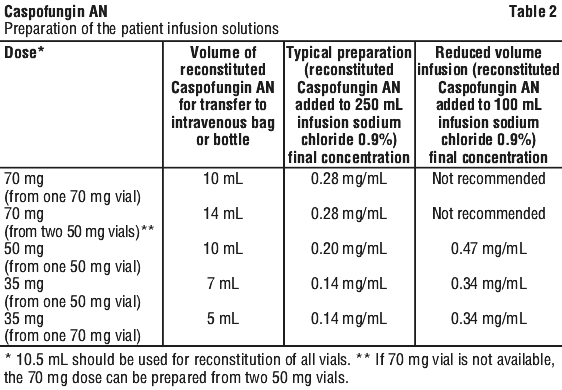

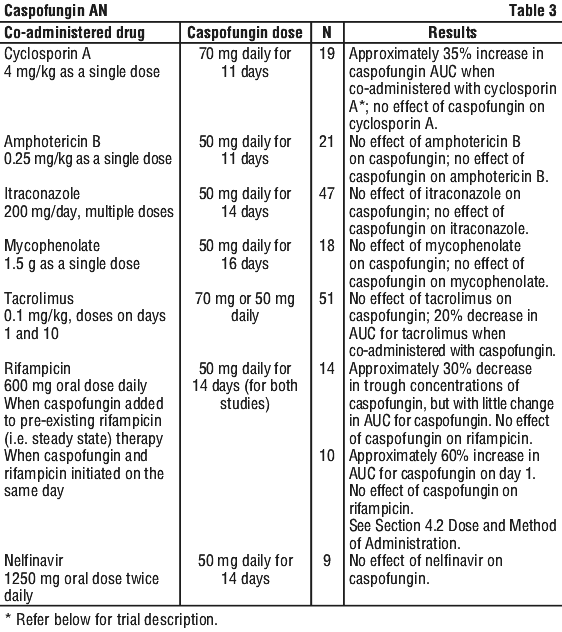
 Caspofungin has also been evaluated at 150 mg daily (for up to 51 days) in 100 adult patients (see Section 5.1 Pharmacodynamic Properties). The study compared caspofungin at 50 mg daily (following a 70 mg loading dose on Day 1) versus 150 mg daily in the treatment of invasive candidiasis. In this group of patients, the safety of caspofungin at this higher dose appeared generally similar to patients receiving the 50 mg daily dose of caspofungin. The proportion of patients with a serious drug-related adverse reaction or a drug-related adverse reaction leading to caspofungin discontinuation was comparable in the 2 treatment groups.
 The proportion of patients who experienced an infusion-related adverse event was significantly lower in the group treated with caspofungin (35.1%) than in the group treated with AmBisome (51.6%).
 The incidence of drug-related clinical adverse experiences was significantly lower among patients treated with caspofungin (28.9%) than among patients treated with amphotericin B (58.4%). Also, the proportion of patients who experienced an infusion-related adverse event was significantly lower in the caspofungin group (20.2%) than in the amphotericin B group (48.8%).


 One patient (0.6%) receiving caspofungin and three patients (11.5%) receiving AmBisome developed a serious drug-related clinical adverse experience. Two patients (1.2%) were discontinued from caspofungin and three patients (11.5%) were discontinued from AmBisome due to a drug-related clinical adverse experience. The proportion of patients who experienced an infusion-related adverse event was 21.6% in the group treated with caspofungin and 34.6% in the group treated with AmBisome.
 The percentage of patients with either a drug-related clinical or a drug-related laboratory adverse experience was significantly lower among patients receiving caspofungin (54.4%) than among patients receiving AmBisome (69.3%). Furthermore, the incidence of discontinuation due to a drug-related clinical or laboratory adverse experience was significantly lower among patients treated with caspofungin (5.0%) than among patients treated with AmBisome (8.0%).
 The incidence of drug-related laboratory adverse experiences was significantly lower among patients receiving caspofungin (24.3%) than among patients receiving amphotericin B (54.0%).


 There are no established breakpoints for caspofungin against Candida species using the European Committee for Antimicrobial Susceptibility Testing (EUCAST) method.
 Based on overall favourable response rates, caspofungin was as effective as AmBisome in empirical therapy of persistent febrile neutropenia. Caspofungin had significantly higher favourable response rates than AmBisome for the following criteria: successful treatment of any baseline fungal infection (caspofungin 51.9%, AmBisome 25.9%) and absence of premature discontinuation from study therapy due to toxicity or lack of efficacy (caspofungin 89.7%, AmBisome 85.5%). Caspofungin was comparable to AmBisome for the other criteria (absence of a breakthrough fungal infection, survival for 7 days after the end of treatment, and resolution of fever during neutropenia).
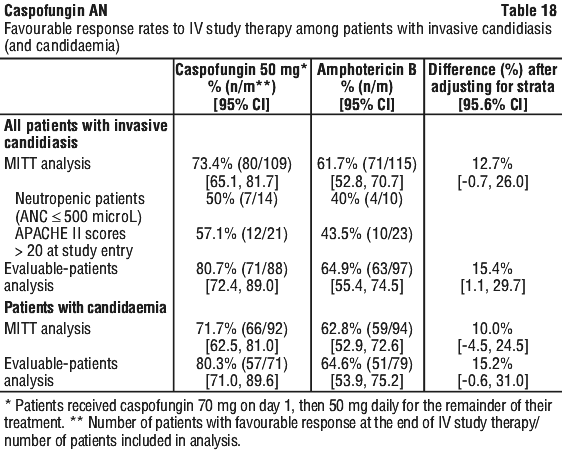 Response rates were also consistent across all identified Candida species. For all other efficacy time points (Day 10 of IV study therapy, end of all antifungal therapy, 2-week post-therapy follow-up, and 6- to 8-week post-therapy follow-up), caspofungin was as effective as amphotericin B. Caspofungin was also comparable to amphotericin B with regard to relapse or survival rates, with an overall mortality among MITT patients during the study treatment period and 6 to 8-week follow-up period of 33.0% in the caspofungin group and 30.4% in the amphotericin B group.
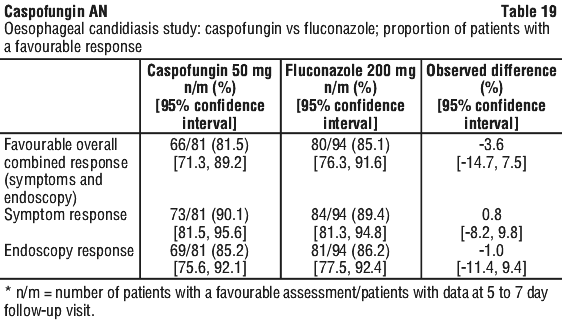 In addition, two double-blind, comparative dose-ranging studies evaluated 3 different doses of caspofungin (35, 50, 70 mg/day) and amphotericin B (0.5 mg/kg/day). These clinical studies support the use of caspofungin 50 mg daily in the treatment of oesophageal candidiasis. Increasing doses of caspofungin above 50 mg daily provided no additional benefit in the treatment of oesophageal candidiasis.
