



What is in this leaflet
This leaflet answers some common questions about Minirin Tablets.
It does not contain all the available information. It does not replace talking to your doctor or pharmacist.
All medicines have risks and benefits. Your doctor has weighed the risks of you taking Minirin Tablets against the benefits they expect it will have for you.
If you have any concerns about taking this medicine, ask your doctor or pharmacist.
Keep this leaflet with the medicine. You may need to read it again.
What Minirin is used for
The active ingredient, desmopressin acetate in Minirin Tablets is a synthetic version of a naturally occurring substance produced in the brain called vasopressin.
It has a number of different actions on the body including an action on the kidney to reduce the amount of urine produced. This means that Minirin Tablets can be used for several different conditions including:
- primary nocturnal enuresis (bedwetting) in patients over 6 years of age who have a normal ability to concentrate urine and who have not responded to treatment with an enuresis alarm or in whom an enuresis alarm is contraindicated or inappropriate
- cranial diabetes insipidus (large amounts of urine being produced day and night and constant thirst).
Ask your doctor if you have any questions about why this medicine has been prescribed for you. Your doctor may have prescribed it for another reason.
This medicine is not addictive.
It is available only with a doctor's prescription.
This medicine is not expected to affect your ability to drive a car or operate machinery.
Before you take Minirin
When you must not take it
Do not take Minirin Tablets if you have an allergy to:
- any medicine containing desmopressin or any of the ingredients listed at the end of this leaflet.
Some of the symptoms of an allergic reaction may include:
- shortness of breath, wheezing or difficulty breathing
- swelling of the face, lips, tongue or other parts of the body
- rash, itching or hives on the skin.
Do not take Minirin Tablets if you:
- are in the habit of drinking large amounts of fluid
- have cardiac insufficiency (shortness of breath, swelling of feet or legs due to fluid build-up)
- have kidney disease where you pass little or no urine
- have low levels of sodium in your bloodstream
- have a disease which causes excessive release of anti-diuretic hormone.
Do not breast-feed if you are taking this medicine. Minirin Tablets are not recommended while you are breast-feeding.
Do not give this medicine to a child under the age of 6 years. Safety and effectiveness in children younger than 6 years have not been established.
Do not take this medicine after the expiry date printed on the pack or if the packaging is torn or shows signs of tampering. If it has expired or is damaged, return it to your pharmacist for disposal.
If you are not sure whether you should start taking this medicine, talk to your doctor.
Before you start to take it
Tell your doctor if you have allergies to any other medicines, foods, preservatives or dyes.
Tell your doctor if you have allergy or intolerance to lactose.
Tell your doctor if you have or have had any of the following medical conditions:
- a known allergy to anti-diuretic hormone
- too little or too much fluid in the body
- heart or blood vessel disease or any other disease for which you take diuretics
- low blood pressure
- cystic fibrosis or any other disease which causes fluid or salt imbalance
- any disease of the blood clotting cells (platelets)
- serious problems with bladder function or with passing urine
- galactose intolerance
- raised pressure within your head (increased intracranial pressure).
Tell your doctor if you are pregnant or plan to become pregnant or are breast-feeding.
Minirin Tablets should only be used in a pregnant woman if necessary. Your doctor can discuss with you the risks and benefits involved.
It is recommended that you do not breastfeed while using Minirin Tablets.
If you have not told your doctor about any of the above, tell him/her before you start taking Minirin Tablets.
Taking other medicines
Tell your doctor or pharmacist if you are taking any other medicines, including any that you get without a prescription from your pharmacy, supermarket or health food shop.
Some medicines and Minirin Tablets may interfere with each other. These include:
- loperamide, a medicine used to stop diarrhoea
- medications which are known to release antidiuretic hormone (eg tricyclic antidepressants, chlorpromazine or carbamazepine) or some medications which are known to treat sugar diabetes, as they can increase the risk of fluid build-up in the body
- non-steroidal anti-inflammatory drugs (NSAIDs), medicines used to relieve pain and inflammation. NSAIDs may induce water retention/low sodium levels in the blood (hyponatraemia).
These medicines may be affected by Minirin Tablets or may affect how well it works. You may need different amounts of your medicines, or you may need to take different medicines.
Your doctor and pharmacist have more information on medicines to be careful with or avoid while taking this medicine.
How to take Minirin
Follow all directions given to you by your doctor or pharmacist carefully. They may differ from the information contained in this leaflet.
If you do not understand the instructions in the leaflet, ask your doctor or pharmacist for help.
Some of the details for Minirin Tablets will vary depending on the purpose for which it is used.
How much to take
Some of the details for Minirin Tablets will vary depending on the purpose for which it is used.
Bedwetting (nocturnal enuresis)
The usual starting dose is one tablet (200 micrograms) at bedtime. If this dose does not adequately resolve the bedwetting, your doctor may recommend that you increase the dose up to two tablets (400 micrograms) at bedtime.
If after four weeks of Minirin treatment there has been no resolution of the bedwetting, treatment should be stopped.
Fluid intake should be limited in preparation for your dose of Minirin Tablets (see 'Things to be careful of').
Cranial diabetes insipidus
The dose you need will be adjusted to suit your personal requirements. Doses of up to 200 micrograms three times daily are often used. Your doctor will advise you about the dose that is most suitable for you.
When to take it
Bedwetting (nocturnal enuresis)
- take Minirin Tablets at bedtime.
Cranial diabetes insipidus
- take Minirin Tablets at times specified by your doctor.
How long to take it
Continue taking your medicine for as long as your doctor tells you. This medicine helps to control your condition, but does not cure it. It is important to keep taking your medicine even if you feel well.
Bedwetting (nocturnal enuresis)
Minirin Tablets for bedwetting is usually taken for periods up to 3 months.
After this period you should have at least one week without Minirin Tablets to check if your bedwetting has stopped. If not, continue for another 3 months.
Cranial diabetes insipidus
Your doctor will advise you.
If a dose is missed
Bedwetting (nocturnal enuresis)
Skip the missed dose and take the next dose when you are meant to.
Cranial diabetes insipidus
Take the next dose as soon as you remember. You will then have to adjust the time of the following dose.
When this is done, go back to taking your medicine as you would normally. You should talk to your doctor about this situation. Do not take a double dose.
If you are not sure what to do, ask your doctor or pharmacist.
If you have trouble remembering to take your medicine, ask your pharmacist for some hints.
If you take too much (overdose)
Immediately telephone your doctor or the Poisons Information Centre (telephone 13 11 26) for advice, or go to Accident and Emergency at the nearest hospital, if you think that you or anyone else may have taken too much Minirin Tablets. Do this even if there are no signs of discomfort or poisoning. You may need urgent medical attention.
Symptoms of an overdose may include confusion, drowsiness, continuing headache, nausea or vomiting, rapid weight gain due to a build-up of water in the body, or, in severe cases, convulsions.
While you are taking Minirin
Things you must do
If you are about to be started on any new medicine, remind your doctor and pharmacist that you are taking Minirin Tablets.
Tell any other doctors, dentists, and pharmacists who treat you that you are taking this medicine.
If you are going to have surgery, tell the surgeon or anaesthetist that you are taking this medicine. It may affect other medicines used during surgery.
If you become pregnant while taking this medicine, tell your doctor immediately.
If you are about to have any blood tests, tell your doctor that you are taking this medicine. It may interfere with the results of some tests.
Keep all of your doctor's appointments so that your progress can be checked. Your doctor may do some tests from time to time to make sure the medicine is working and to prevent unwanted side effects.
Things you must not do
Do not take Minirin Tablets to treat any other complaints unless your doctor tells you to.
Do not give your medicine to anyone else, even if they have the same condition as you.
Do not stop taking your medicine or lower the dosage without checking with your doctor. If you stop taking it suddenly, your condition may worsen.
Things to be careful of
Bedwetting (nocturnal enuresis)
You must avoid drinking fluids from one hour before taking Minirin Tablets until the next morning (at least eight hours). Over this period, drink no more than a few sips of water or other fluids. This is because a high fluid intake during this period can increase the chance that you will feel unwell (e.g. headache, nausea, dizziness).
Remember to drink normally throughout the day. This is very important to prevent dehydration during daytime.
Cranial diabetes insipidus
Carefully follow your doctor's instruction about fluid intake. It is very important to keep your body water in balance.
Side effects
Tell your doctor or pharmacist as soon as possible if you do not feel well while you are taking Minirin Tablets.
This medicine helps most people but it may have unwanted side effects in a few people. All medicines can have side effects. Sometimes they are serious, most of the time they are not. You may need medical attention if you get some of the side effects.
If you are over 65 years of age, commencing Minirin treatment is not recommended.
The elderly may be at an increased risk of some side effects.
Do not be alarmed by the following lists of side effects. You may not experience any of them.
Ask your doctor or pharmacist to answer any questions you may have.
Tell your doctor or pharmacist if you notice any of the following and they worry you:
- headache
- stomach pain or nausea.
The above list includes the more common side effects of your medicine. They are usually mild and short-lived.
Tell your doctor as soon as possible if you notice any of the following:
- emotional, behavioural and visual disturbances
- allergic reactions including skin rash or more general reactions
- bladder problems
- fatigue
- swelling of hands, ankles or feet.
The above list includes serious side effects which may require medical attention. Serious side effects are rare.
If you notice any of the following, tell your doctor immediately or go to Accident and Emergency at your nearest hospital:
- confusion or drowsiness
- sleepiness
- continuing headache
- nausea or vomiting
- rapid weight gain, which may be due to a build-up of water in the body
- convulsions, fitting and blackouts
- high blood pressure.
The above signs and symptoms may be due to low levels of sodium in the blood, a rare, but serious possible side effects of Minirin. You may need urgent medical attention or hospitalisation.
Tell your doctor or pharmacist if you notice anything that is making you feel unwell.
Other side effects not listed above may also occur in some people.
After taking Minirin
Storage
Keep Minirin Tablets in the original container in order to protect from moisture and light until it is time to take it. If you take the tablets out of the bottle they will not keep well.
Keep your tablets in a cool dry place where the temperature stays below 25°C. Keep the container tightly closed and do not remove the desiccant capsule from the cap.
Do not store Minirin Tablets or any other medicine in the bathroom or near a sink. Do not leave it on a window sill or in the car. Heat and dampness can destroy some medicines.
Keep it where children cannot reach it. A locked cupboard at least one-and-a-half metres above the ground is a good place to store medicines.
Disposal
If your doctor tells you to stop taking this medicine or the expiry date has passed, ask your pharmacist what to do with any medicine that is left over.
Product description
What it looks like
Minirin Tablets are supplied in bottles of 30 tablets.
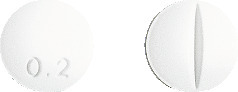
Minirin Tablets 200 micrograms are white, round and convex tablets with a single score and marked '0.2' on one side.
Do not use this product if the packaging appears damaged in any way. Do not take the tablets if they appear different from the descriptions above or if they look unusual in any way.
Ingredients
Minirin Tablets contains 200 micrograms of desmopressin acetate, as the active ingredient.
They also contain:
- povidone
- lactose monohydrate
- potato starch
- magnesium stearate.
This medicine does not contain sucrose, gluten, tartrazine or any other azo dyes.
Sponsor
Minirin Tablets are supplied in Australia by:
Ferring Pharmaceuticals Pty Ltd
Suite 2, Level 1, Building 1
20 Bridge Street
Pymble, NSW 2073
Toll free: 1800 337 746
AUST R 93731
Minirin desmopressin acetate 200 micrograms tablets
This leaflet was prepared in July 2019
DOCS#1720-v13
Published by MIMS October 2019
 Based on the frequency of adverse drug reactions reported in clinical trials with oral desmopressin conducted in children and adolescents for treatment of primary nocturnal enuresis (N = 1923), the following adverse events have been listed, see Table 2.

 Study RG-84063-607 differed in that patients could subsequently enter an ascending dose titration period lasting up to 8 weeks in which patients were randomised to receive either 200 microgram of Minirin or placebo. Patients who were not completely dry at the end of two weeks had their study medication increased in increments of 1 (200 microgram) tablet. If required, this titration was repeated at 2 weekly intervals to a maximum of 3 tablets (see Table 5 for results). Whilst some patients treated with 200 microgram/day and 400 microgram/day of Minirin were completely dry after two weeks, the majority were not and required titration to 600 microgram/day.
 An uncontrolled long-term study (45A06-62 CESE) was conducted in 294 patients, aged 6-18 years. Those patients (n = 256) with a minimum of 10 wet nights during a 28 day observation period were treated with 200 microgram/day Minirin for a period of 2 weeks. Those achieving a ≥ 90% reduction in the number of wet nights (full response) compared to the observation period were treated for 12 weeks at 200 microgram Minirin. The remaining patients were titrated to 400 microgram/day Minirin for a further 2 weeks and, if they achieved ≥ 50% reduction in the number of wet nights, were then treated for 12 weeks at this dose. The other patients were withdrawn from the study. 16 of 253 (6.3%) patients receiving 200 microgram Minirin achieved a ≥ 90% reduction in the number of wet nights (full response). 237 patients received 400 microgram Minirin of whom 107 achieved a ≥ 50% reduction in the number of wet nights.
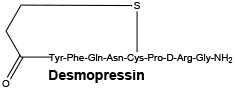 Synonyms of desmopressin: DDAVP.