



What is in this leaflet
This leaflet answers some common questions about Ondansetron Accord Injection. It does not contain all the available information.
It does not take the place of talking to your doctor or pharmacist.
All medicines have risks and benefits. Your doctor has weighed the risks of you taking Ondansetron Accord Injection against the benefits this medicine is expected to have for you.
This medicine is likely to be used while you are at the clinic or in hospital. If possible, please read this leaflet carefully before this medicine is given to you. In some cases this leaflet may be given to you after the medicine has been used.
If you have any concerns about taking this medicine, ask your doctor or pharmacist.
Keep this leaflet. You may need to read it again.
What Ondansetron Accord is used for
Ondansetron Accord Injection contains a medicine called ondansetron. This belongs to a group of medicines called antiemetics/antinauseants.
Ondansetron Accord Injection is used to prevent the nausea (feeling sick) and vomiting that may occur after surgery or after therapy with anticancer medicines (chemotherapy) or radiation.
Ondansetron Accord Injection may be used for the management of other conditions that are not mentioned above. Your doctor will be able to tell you about the specific condition for which you have been prescribed Ondansetron Accord Injection.
This medicine is available only with a doctor’s prescription.
Before you are given Ondansetron Accord
When you must not be given it
Do not use Ondansetron Accord Injection if:
- you have an allergy to ondansetron or any of the ingredients listed at the end of this leaflet
- you are pregnant or trying to become pregnant
- you are breastfeeding
- you are taking apomorphine (used to treat Parkinson’s disease)
If you are not sure whether any of these apply to you, check with your doctor.
Before you are given it
Tell your doctor if:
- you have any allergies to:
- any other medicine
- any other substances, such as foods, preservatives or dyes - you are pregnant or intend to become pregnant
- you are breastfeeding or plan to breastfeed
- you have liver problems
- you have an abnormal heart rhythm (QT prolongation)
- you have any blood problems, including abnormal salt levels in your blood.
Taking other medicines
Tell your doctor if you are taking any other medicines, including any that you buy without a prescription from your pharmacy, supermarket or health food shop.
Some medicines and ondansetron may interfere with each other. These include:
- pain killers such as tramadol
- antibacterials such as rifampicin
- medicines that are known to lead to an abnormal heart rhythm (QT prolongation)
Your doctor will advise you about any dosage adjustments needed and continuing to take other medicines while you are receiving Ondansetron Accord Injection.
How Ondansetron Accord is given
Ondansetron Accord Injection is given by injection into the muscle or by slow injection into a vein. It must only be given by a doctor or nurse.
Your doctor will decide what dose and how long you will receive Ondansetron Accord Injection.
The clinical safety of Ondansetron in children under 2 years has not been established.
If you are given too much (overdose)
This rarely happens as Ondansetron Accord Injection is administered under the care of a highly trained doctor.
However, if you are given too much ondansetron, you may experience some of the effects listed under “Side effects” below.
Your doctor has information on how to recognise and treat an overdose.
Ask your doctor if you have any concerns.
Side Effects
Tell your doctor or nurse as soon as possible if you do not feel well while you are being given Ondansetron Accord Injection or if your nausea and vomiting does not go away.
Like other medicines, Ondansetron Accord Injection can cause some side effects. If they occur, most are likely to be minor or temporary. However, some may be serious and need medical attention.
Ask your doctor or pharmacist to answer any questions that you may have.
Do not be alarmed by this list of possible side effects. You may not experience any of them.
Tell your doctor or nurse if you notice any of the following:
- headache
- a sensation of warmth or flushing
- mild stomach cramps
- constipation or diarrhoea
- dry mouth
- pain, redness or burning at place of injection
- hiccups
These are all common side effects.
Tell your doctor or nurse immediately if you notice any of the following:
- ‘wheezy’ symptoms
- chest pain or tightness of the chest
- changes in the way your heart beats, e.g. if you notice it beating faster or slower than normal, or if it beats irregularly or if it ‘throbs’
- disturbance in heart rhythm (sometimes causing a sudden loss of consciousness)
- patients may experience “serotonin syndrome” (confusion, sweating, unsteadiness, shaking, diarrhoea) when Ondansetron Accord Injection is taken in combination with other serotonergic drugs can include certain types of antidepressants, opioid pain medicines such as tramadol and fentanyl, and lithium. Please note, this is not an exhaustive list. Please discuss with your pharmacist or doctor if you have any concerns.
- Severe skin reaction where the top layer of the skin detaches from the lower layers.
- low blood pressure
- fits or convulsions
- swelling of the eyelids, face, lips, mouth or throat which may cause difficulty in swallowing or breathing
- skin rash, skin lumps or hives
- blurred vision
- dizziness
These are serious side effects, some of which include symptoms of an allergic reaction. You may need urgent medical attention. Serious side effects are rare.
Other side effects not listed above may also occur in some patients.
Storage
Stored below 25°C. Protect from Light.
Disposal
Any Ondansetron Accord from a single dose preparation which is not used, will be disposed of in a safe manner by your doctor or pharmacist.
Product Description
What it looks like
Ondansetron Accord Injection is a clear, colourless to almost colourless solution in a clear or amber glass ampoules in packs of 5 or 10. Or in a syringe in a 1 pack.
Not all presentations and pack sizes may be marketed.
Ingredients
Active ingredient:
Ondansetron (as ondansetron hydrochloride dihydrate)
Inactive ingredients:
sodium chloride
sodium citrate dihydrate
citric acid monohydrate
sodium hydroxide
hydrochloric acid
water for injections
Name and Address of the Sponsor
Accord Healthcare Pty Ltd
Level 24, 570 Bourke Street
Melbourne, VIC, 3000
Australia
Australian Registration Numbers
Ampoule
4 mg/2 mL: AUST R 205594
8 mg/4 mL: AUST R 205599
Syringe
4 mg/2 mL: AUST R 338224
8 mg/4 mL: AUST R 338227
Date of Preparation
This leaflet was prepared on 09 November 2020.
Published by MIMS December 2020

 The overall incidence of adverse events was similar for ondansetron (53%) and placebo (56%). The most commonly reported adverse events were eye disorder(s) as a result of ophthalmic operations, wound problems at the surgical site, nausea and/or vomiting, drowsiness/sedation, anxiety/agitation and headache. These events are not unexpected in patients undergoing surgery and there was little difference of these between treatment groups. However, the incidence of nausea and/or vomiting reported as an adverse event was significantly higher in patients who had received placebo (11%) compared to those who had received ondansetron (6%).
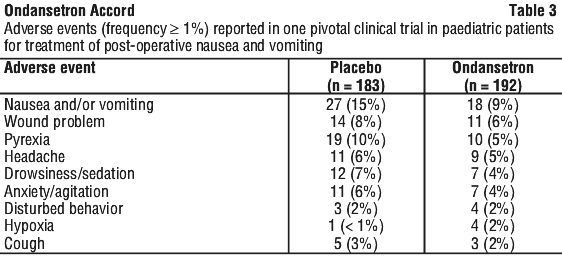 Fewer adverse events were reported with ondansetron (36%) than with placebo (47%). The most common adverse events were similar to those reported in clinical trials for the prevention of post-operative nausea and vomiting.
 The overall incidence rate was 45% in the placebo group and 47% in the intravenous ondansetron group.
