Consumer medicine information

Radpharm MDP

Technetium (99mTc) medronate

BRAND INFORMATION

Brand name

Radpharm MDP

Active ingredient

Technetium (99mTc) medronate

Schedule

Unscheduled


Consumer medicine information (CMI) leaflet

Please read this leaflet carefully before you start using Radpharm MDP.

SUMMARY CMI

RADPHARM MDP

Consumer Medicine Information (CMI) summary

The full CMI on the next page has more details. If you are worried about using this medicine, speak to your doctor or pharmacist.

1. Why am I using RADPHARM MDP?

RADPHARM MDP contains the active ingredient Medronic acid. RADPHARM MDP is used for skeletal imaging.

For more information, see Section 1. Why am I using RADPHARM MDP? in the full CMI.

2. What should I know before I use RADPHARM MDP?

Do not use if you have ever had an allergic reaction to RADPHARM MDP or any of the ingredients listed at the end of the CMI.

Talk to your doctor if you have any other medical conditions, take any other medicines, or are pregnant or plan to become pregnant or are breastfeeding.

For more information, see Section 2. What should I know before I use RADPHARM MDP? in the full CMI.

3. What if I am taking other medicines?

Some medicines may interfere with RADPHARM MDP and affect how it works.

A list of these medicines is in Section 3. What if I am taking other medicines? in the full CMI.

4. How do I use RADPHARM MDP?

  • Your doctor or health care provider will decide how much RADPHARM MDP you will be given. This depends on your condition and other factors, such a weight

More instructions can be found in Section 4. How do I use RADPHARM MDP? in the full CMI.

5. What should I know while using RADPHARM MDP?

Things you should do
  • Inform your doctor or health care provider immediately if you do not feel well during the injection or after being given RADPHARM MDP.
Things you should not do
  • Do not take any other medicines until advised by your doctor
Driving or using machines
  • Do not drive or operate machinery until you know how RADPHARM MDP affects you.

For more information, see Section 5. What should I know while using RADPHARM MDP? in the full CMI.

6. Are there any side effects?

Reported side effects of RADPHARM MDP include, Hypersensitivity reactions, local or generalized rash, itching, dermal irritation.

For more information, including what to do if you have any side effects, see Section 6. Are there any side effects? in the full CMI.


FULL CMI

RADPHARM MDP

Active ingredient(s): Medronic acid


Consumer Medicine Information (CMI)

This leaflet provides important information about using RADPHARM MDP. You should also speak to your doctor or pharmacist if you would like further information or if you have any concerns or questions about using RADPHARM MDP.

Where to find information in this leaflet:

1. Why am I using RADPHARM MDP?
2. What should I know before I use RADPHARM MDP?
3. What if I am taking other medicines?
4. How do I use RADPHARM MDP?
5. What should I know while using RADPHARM MDP?
6. Are there any side effects?
7. Product details

1. Why am I using RADPHARM MDP?

RADPHARM MDP contains the active ingredient Medronic acid. RADPHARM MDP is a prescription medicine which is only available to the Healthcare Practitioners for diagnostic use only. It belongs to a group of medicines called radiopharmaceutical agents, which are radioactive. It is administered to you via intravenous injection after mixing with a radioactive solution.

RADPHARM MDP is mixed with Technetium (99mTc) before injection. RADPHARM MDP is used for imaging the skeletal system.

Your doctor may have prescribed RADPHARM MDP for another purpose. Ask your doctor if you have any questions about why RADPHARM MDP has been prescribed for you. If you have any concerns, you should discuss these with your doctor.

2. What should I know before I use RADPHARM MDP?

Warnings

Do not use RADPHARM MDP if:

  • you are allergic to Medronic acid, or any of the ingredients listed at the end of this leaflet.
  • Always check the ingredients to make sure you can use this medicine.

Check with your doctor if you:

  • have any other medical conditions
  • take any medicines for any other condition including medicines that you buy without a prescription from the pharmacy, supermarket or health food shop.
  • Have any allergies to ingredients listed at the end of this leaflet or any other substances such as foods, preservatives or dyes.

During treatment, you may be at risk of developing certain side effects. It is important you understand these risks and how to monitor for them. See additional information under Section 6. Are there any side effects?

Pregnancy and breastfeeding

Check with your doctor if you are pregnant or intend to become pregnant. Like most medicines, RADPHARM MDP is not recommended for use during pregnancy. If there is a need to consider RADPHARM MDP during your pregnancy, your doctor will discuss the benefits and risks of giving it to you

Talk to your doctor if you are breastfeeding or intend to breastfeed. Do not breast feed after the administration of RADPHARM MDP for a period no less than 4 hours.

3. What if I am taking other medicines?

Tell your doctor or pharmacist if you are taking any other medicines, including any medicines, vitamins or supplements that you buy without a prescription from your pharmacy, supermarket or health food shop.

Check with your doctor or pharmacist if you are not sure about what medicines, vitamins or supplements you are taking and if these affect RADPHARM MDP.

4. How do I use RADPHARM MDP?

How much to take / use

  • Your doctor will decide how much you will be given RAPDHARM MDP. This depends on your condition and other factors, such as weight.

When to take / use RADPHARM MDP

  • RAPDHARM MDP will only be given to you by a doctor or licensed health care practitioner. They will decide when you will be given RAPDHARM MDP.

If you use too much RADPHARM MDP

If you think that you have been given too much RADPHARM MDP, you may need urgent medical attention.

You should immediately:

  • phone the Poisons Information Centre
    (by calling 13 11 26), or
  • contact your doctor, or
  • go to the Emergency Department at your nearest hospital.

You should do this even if there are no signs of discomfort or poisoning.

5. What should I know while using RADPHARM MDP?

Things you should do

Call your doctor straight away if you do not feel well during the injection or after being given RADPARM MDP

Things you should not do

  • Do not take any other medicines until advised by your doctor.

Driving or using machines

Be careful before you drive or use any machines or tools until you know how RADPHARM MDP affects you.

RADPHARM MDP may cause dizziness in some people Make sure you know how you react to RADPHARM MDP before you drive a car, operate machinery or do anything else that could be dangerous if you are dizzy,

Do not drive or operate machinery until you know how RADPHARD affects you.

6. Are there any side effects?

All medicines can have side effects. If you do experience any side effects, most of them are minor and temporary. However, some side effects may need medical attention.

See the information below and, if you need to, ask your doctor or pharmacist if you have any further questions about side effects.

Less serious side effects

Less serious side effectsWhat to do
  • local or generalized rash,
  • itching,
  • Skin irritation
  • Hypersensitivity reactions
Speak to your doctor if you have any of these less serious side effects and they worry you.

Serious side effects

Serious side effectsWhat to do
  • No serious side effects reported currently.
 

Do not be alarmed by this list of side effects. You may not experience any of them.

Tell your doctor or pharmacist if you notice anything else that may be making you feel unwell.

Other side effects not listed here may occur in some people.

Reporting side effects

After you have received medical advice for any side effects you experience, you can report side effects to the Therapeutic Goods Administration online at www.tga.gov.au/reporting-problems. By reporting side effects, you can help provide more information on the safety of this medicine.

Always make sure you speak to your doctor or pharmacist before you decide to stop taking any of your medicines.

7. Product details

This medicine is only available with a doctor's prescription and only made available to your doctor or healthcare provider.

What RADPHARM MDP contains

Active ingredient
(main ingredient)
medronic acid
Other ingredients
(inactive ingredients)
ascorbic acid
stannous chloride
Potential allergensNone

Do not take this medicine if you are allergic to any of these ingredients.

What RADPHARM MDP looks like

RADPHARM MDP is available as a dry white lyophilised powder in a 10mL vacuum sealed tinted vial (Aust R 14330).

An injection is prepared from the vial by a licensced health care provider immediately before it is administered to you.

Who distributes RADPHARM MDP

Global Medical Solutions Australia Pty Limited T/A Radpharm Scientific
53-57 Oatley Court, BELCONNEN, ACT 2617 Australia

This leaflet was prepared in 07/2022.

Published by MIMS April 2023

BRAND INFORMATION

Brand name

Radpharm MDP

Active ingredient

Technetium (99mTc) medronate

Schedule

Unscheduled


1 Name of Medicine

Medronic acid.

2 Qualitative and Quantitative Composition

Radpharm MDP Kit consists of sterile, pyrogen free, lyophilised ingredients which need reconstitution with sodium pertechnetate (99mTc) injection to produce a technetium [99mTc] medronate complex suitable for bone scanning. The precise structure of the technetium [99mTc] medronate complex is not known at this time.
Each vial contains the following active ingredient and excipient as a lyophilized powder:

Active ingredient.

10 mg of medronic acid.

Excipient.

1 mg of stannous chloride; 1 mg of ascorbic acid.
The product contains no preservatives.

3 Pharmaceutical Form

Radpharm MDP is available as a dry white lyophilised powder in 10 mL vacuum sealed vials for intravenous injection.

4 Clinical Particulars

4.1 Therapeutic Indications

Technetium [99mTc] medronate may be used as a skeletal imaging pharmaceutical.

4.2 Dose and Method of Administration

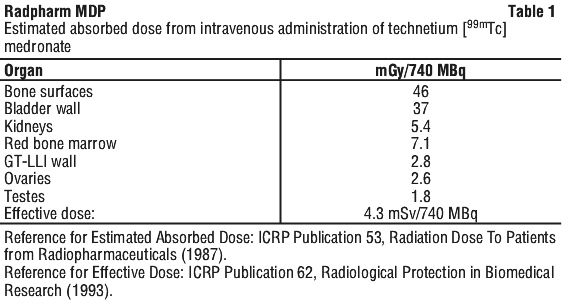
Recommended intravenous dose for the normal adult is 740 MBq.

Radiation dosimetry.

See Table 1.
Procedure.

Note.

If there is no vacuum, discard vial and do not deliver the sodium pertechnetate [99mTc] injection.
1. Place Radpharm MDP vial in a shielding container.
2. Draw a suitable volume (2 to 8 mL) of sodium pertechnetate [99mTc] injection eluted from a technetium-99m generator (1 to 16 GBq), and inject into the Radpharm MDP vial. Mix by inversion for 20 seconds and leave standing at room temperature for 10 minutes before use.
3. Determine the radioactivity per millilitre, label the container and calculate the patient dose.
4. The technetium [99mTc] medronate solution is stable at room temperature and may be used up to 8 hours after preparation.

Note.

In order to reduce the radiation dose to the bladder and other organs, the patient should be encouraged to drink and void as frequently as possible for a period of 4 to 6 hours after the administration of technetium [99mTc] medronate.

4.3 Contraindications

None known.

4.4 Special Warnings and Precautions for Use

Radiopharmaceuticals should be used only by physicians who are qualified by specific training in the safe use and handling of radionuclides.
Contents of the vial are intended only for use in the preparation of technetium [99mTc] medronate.
The radioactivity of the dose should be checked with a suitable instrument immediately prior to administration.

Use in the elderly.

No data available.

Paediatric use.

No data available.

Effects on laboratory tests.

No data available.

4.5 Interactions with Other Medicines and Other Forms of Interactions

None known.

4.6 Fertility, Pregnancy and Lactation

Effects on fertility.

No data available.
(Category C)
Technetium-99m radiopharmaceuticals should only be given to a pregnant woman if in the judgement of the treating physician the expected benefits outweigh the potential hazards.
Technetium-99m is excreted in human milk. Interruption to breast feeding is not essential after the administration of a technetium [99mTc] medronate (a mother can be reassured by advising an interruption of 4 hr).
(Reference: L.K. Harding, A. Bossuyt, S. Pellet, C. Reiners, J.N. Talbot, "Recommendations for nuclear medicine physicians regarding breastfeeding mothers", Eur. J. Nucl. Med., 1995, 22, BP17).

4.7 Effects on Ability to Drive and Use Machines

The effects of this medicine on a person's ability to drive and use machines were not assessed as part of its registration.

4.8 Adverse Effects (Undesirable Effects)

For each patient, exposure to ionising radiation must be justifiable on the basis of likely benefit. The activity administered must be such that the resulting dose is as low as reasonably achievable bearing in mind the need to obtain the intended diagnostic or therapeutic result.
Exposure to ionising radiation is linked with cancer induction and a potential for development of hereditary defects. For diagnostic nuclear medicine investigations the current evidence suggests that these adverse effects will occur with low frequency because of the low radiation doses incurred.
For most diagnostic investigations using a nuclear medicine procedure the radiation dose delivered (EDE) is less than 20 mSv. Higher doses may be justified in some clinical circumstances.
Occasionally (approximately 0.5 out of 100,000 investigations), hypersensitivity reactions may occur following intravenous administration of technetium [99mTc] medronate. Cases of local rash or generalised rash with itching and dermal irritation have been reported. Onset of the reaction is commonly several hours post-injection and it may last up to 48 hours. Treatment with a non-selective histamine H1 antagonist is helpful.

Reporting suspected adverse effects.

Reporting suspected adverse reactions after registration of the medicinal product is important. It allows continued monitoring of the benefit-risk balance of the medicinal product. Healthcare professionals are asked to report any suspected adverse reactions at www.tga.gov.au/reporting-problems.

4.9 Overdose

For information on the management of overdose, contact the Poisons Information Centre on 13 11 26 (Australia).

5 Pharmacological Properties

5.1 Pharmacodynamic Properties

Mechanism of action.

Physical characteristics of Technetium-99m.

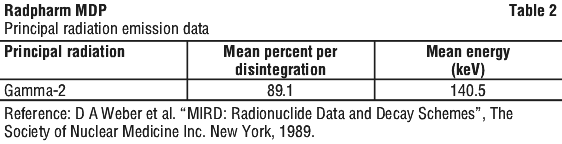
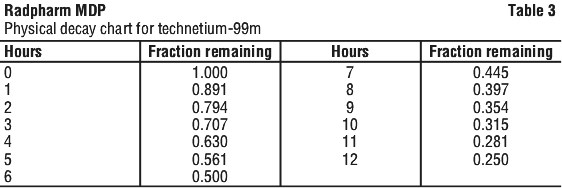
Technetium-99m with a physical half life of 6 hours decays by isomeric transition to technetium-99. Photons associated with this transition that are useful for detection and imaging studies are listed in Tables 2 and 3.

External radiation.

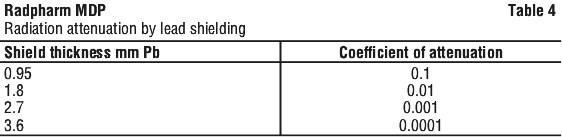
The specific gamma ray constant for technetium-99m is 0.19 mGy/MBq-h at 1 cm. The first half value thickness of lead (Pb) for technetium-99m is 0.2 mm. Attenuation by lead is given in Table 4.

Clinical trials.

No data available.

5.2 Pharmacokinetic Properties

After intravenous administration of technetium [99mTc] medronate, skeletal uptake appears to be related to bone metabolic activity and skeletal blood flow. Technetium [99mTc] medronate demonstrates specific affinity for areas of altered osteogenesis.
Localised areas of decreased bone uptake may occur after therapeutic external irradiation.
Blood clearance of technetium [99mTc] medronate is multiexponential with an initial fall in blood concentration with half-time (t1/2 = 3.5 minutes), followed by medium (t1/2 = 27 minutes) and slow (t1/2 = 144 minutes). The initial blood clearance represents the relatively rapid movement of technetium [99mTc] medronate from the vascular compartments to other compartments. The other clearance rates are functions of bone uptake and renal clearance and protein binding of tracer. Blood levels fall to 3-5% of the injected dose by 3 hours post injection.

5.3 Preclinical Safety Data

Genotoxicity.

No data available.

Carcinogenicity.

No data available.

6 Pharmaceutical Particulars

6.1 List of Excipients

See Section 2 Qualitative and Quantitative Composition.

6.2 Incompatibilities

Incompatibilities were either not assessed or not identified as part of the registration of this medicine.

6.3 Shelf Life

In Australia, information on the shelf life of the Radpharm MDP kit can be found on the public summary of the Australian Register of Therapeutic Goods (ARTG). The expiry date can be found on the packaging.
After reconstitution of Radpharm MDP with sodium pertechnetate [99mTc] injection, (1 to 16 GBq), the technetium [99mTc] medronate complex is stable at room temperature for 8 hours.

6.4 Special Precautions for Storage

The Radpharm MDP kit must be stored at 2°C to 8°C. (Refrigerate. Do not freeze.)

6.5 Nature and Contents of Container

Radpharm MDP kit is supplied as a carton of 10 sterile, pyrogen free, vacuum sealed multidose 10 mL glass Type 1 coloured vials with 1888 grey chlorobutyl lyophilisation stopper and aluminium seal with green flip off.

6.6 Special Precautions for Disposal

In Australia, any unused medicine or radioactive waste material should be disposed off in accordance with Code for the disposal of radioactive wastes by the user which is published on the Australian Radiation Protection and Nuclear Safety Agency (ARPANSA) website as Radiation Protection Series (RPS C-6).

6.7 Physicochemical Properties

Chemical structure.
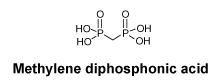

CAS number.

1984-15-2.

7 Medicine Schedule (Poisons Standard)

Unscheduled.

Summary Table of Changes