
What is in this leaflet
This leaflet answers some common questions about TRAZIMERA. It does not contain all the available information.
It does not take the place of talking to your doctor or pharmacist.
All medicines have risks and benefits. Your doctor has weighed the risks of you taking TRAZIMERA against the benefits they expect it will have for you.
If you have any concerns about taking this medicine, ask your doctor or pharmacist.
Keep this leaflet with the medicine. You may need to read it again.
What TRAZIMERA is used for
TRAZIMERA contains an active ingredient called trastuzumab.
TRAZIMERA belongs to a group of medicines known as anti-neoplastic (or anti-cancer) agents. There are many different classes of antineoplastic agents. TRAZIMERA belongs to a class called monoclonal antibodies.
Monoclonal antibodies are proteins made in a laboratory. These proteins are designed to recognise and bind to other unique proteins in the body.
TRAZIMERA binds selectively to a protein called human epidermal growth factor receptor 2 (HER2).
HER2 is found in large amounts on the surface of some cancer cells.
When TRAZIMERA binds to HER2 it stops the growth and spread of the cancer cells.
TRAZIMERA is used to treat breast and gastric cancer. It is only used in patients whose tumour has tested positive to HER2.
TRAZIMERA may be used alone or with other medicines that treat breast cancer, such as an aromatase inhibitor (hormone receptor positive breast cancer) or a taxane (e.g. paclitaxel or docetaxel).
For the treatment of gastric cancer TRAZIMERA is used with chemotherapy medicines cisplatin and capecitabine (or 5FU).
For further information about the other medicines you are receiving with TRAZIMERA, please ask your doctor, nurse or pharmacist for the Consumer Medicine Information (CMI) leaflet.
Ask your doctor if you have any questions about why TRAZIMERA has been prescribed for you.
This medicine is available only with a doctor's prescription.
Before you are given TRAZIMERA
When you must not be given it
Do not use TRAZIMERA if:
- you have had an allergic reaction to;
- any medicine containing trastuzumab
- any of the ingredients listed at the end of this leaflet.
- any protein of Chinese hamster origin
Some of the symptoms of an allergic reaction may include: shortness of breath; wheezing or difficulty breathing; swelling of the face, lips, tongue or other parts of the body; rash, itching or hives on the skin. - you have breast cancer that has not spread (non-metastatic) and
- you have had an LVEF test result (which measures how well your heart can pump blood) of less than 45% or
- you have symptoms of heart failure
Symptoms of heart failure may include:
- shortness of breath or tire easily after light physical activity (such as walking)
- shortness of breath at night, especially when lying flat
- swelling of the hands or feet due to fluid build up
- abnormal or irregular heartbeat
If you are not sure whether you should start receiving this medicine, talk to your doctor.
Before you are given it
Tell your doctor if:
- you have a history of heart disease with:
- angina (chest pain)
- cardiac arrhythmias (abnormal beating of the heart)
- heart failure (where the heart cannot pump blood normally)
- coronary artery disease (also known as CAD, a condition where plaque builds up inside the arteries)
- poorly controlled high blood pressure - you have previously been treated with chemotherapy medicines known as anthracyclines (e.g. doxorubicin); these medicines can damage heart muscle and increase the risk of heart problems with TRAZIMERA
Your doctor will monitor your heart function closely before and during your treatment with TRAZIMERA. Your heart function may also be monitored for years after ceasing TRAZIMERA treatment. - if you have any breathing or lung problems
- you are allergic to any other medicines or any other substances such as foods, preservatives or dyes
Allergic or anaphylactic reactions can occur with TRAZIMERA treatment (known as infusion or administration related reactions). Your doctor or nurse will monitor you for side effects during treatment. See "side effects" for symptoms to look out for. - you are pregnant or intend to become pregnant
TRAZIMERA may be harmful to an unborn baby. If there is a need for TRAZIMERA treatment when you are pregnant your doctor will discuss the risks and benefits to you and the unborn baby.
You should use effective contraception to avoid becoming pregnant while you are being treated with TRAZIMERA and for 7 months after stopping treatment. - you are breast-feeding or plan to breast-feed
It is not known if TRAZIMERA passes into breast milk. It is recommended that you discontinue breast-feeding while you are being treated with TRAZIMERA and not restart breast-feeding until 7 months after completing TRAZIMERA treatment.
If you have not told your doctor about any of the above, tell him/her before you start taking TRAZIMERA.
Use in children
The safety and effectiveness of TRAZIMERA in children under 18 years of age have not been established.
Taking other medicines
Tell your doctor or pharmacist if you are taking any other medicines, including any that you get without a prescription from your pharmacy, supermarket or health food shop.
TRAZIMERA treatment with gemcitabine, vinorelbine, a taxane or radiation therapy can increase the chance of lung problems (interstitial lung disease).
Your doctor and pharmacist have more information on medicines to be careful with or avoid while receiving TRAZIMERA.
Tell your doctor or pharmacist that you have had TRAZIMERA if you start any new medication in the seven months after stopping treatment. It may take up to seven months for TRAZIMERA to be removed from your body
How TRAZIMERA is given
Follow all directions given to you by your doctor or nurse carefully. They may differ from the information contained in this leaflet.
TRAZIMERA must be prepared by a healthcare professional and will be given in a hospital or clinic by a doctor or nurse.
TRAZIMERA is given by "drip" into a vein (intravenous (IV) infusion).
The first TRAZIMERA infusion is given over 90 minutes. If the first infusion is well tolerated, your drip time may be shortened to 30 minutes.
For the treatment of breast cancer, TRAZIMERA is given either once a week or once every three weeks. It may be given alone or in combination with other medicines used to treat breast cancer.
For the treatment of gastric cancer TRAZIMERA is given every three weeks in combination with other medicines used to treat gastric cancer.
Your doctor will decide how long you should receive TRAZIMERA, this will depend on your response to the medicine and the state of your disease.
If you miss a dose
As TRAZIMERA is given under the supervision of your doctor, you are unlikely to miss a dose. However, if you forget or miss your appointment to receive TRAZIMERA, make another appointment as soon as possible.
Your doctor will decide when and how much your next dose of TRAZIMERA will be.
If you are given too much (overdose)
As TRAZIMERA is given to you under the supervision of your doctor it is unlikely that you will be given too much. However, if you experience any side effects after being given TRAZIMERA, tell your doctor immediately.
While you are receiving TRAZIMERA
Things you must do
Tell your doctor or nurse immediately if you have any signs and symptoms of an allergic or anaphylactic reaction
Some signs and symptoms include;
- swelling of your face, lips, tongue or throat with difficulty breathing,
- swelling of other parts of your body
- shortness of breath, wheezing or trouble breathing
- rash, itching or hives on the skin
- feeling sick (nausea)
- fever, chills
- feeling tired
- headache
Tell your doctor or nurse immediately if you have any signs and symptoms of heart problems.
Some signs and symptoms of heart problems are
- shortness of breath or getting tired easily after light physical activity (such as walking)
- shortness of breath at night, especially when lying flat
- swelling of the hands or feet due to fluid build up
- cough
- abnormal or irregular heartbeat
Please follow all your doctors' instructions if any of these symptoms require medication.
Tell any other doctors, dentists, and pharmacists who treat you that you are receiving TRAZIMERA.
Tell your doctor if you become pregnant or intend to start a family while receiving TRAZIMERA.
Keep all of your doctor's appointments so that your progress can be checked. Your doctor may perform regular tests.
Things you must not do
Do not stop your TRAZIMERA treatment without checking with your doctor.
Tell your doctor if you feel that TRAZIMERA is not helping your condition.
Do not take any other medicines, whether they require a prescription or not, without first telling your doctor or consulting with a pharmacist.
Things to be careful of
Be careful driving or operating machinery until you know how TRAZIMERA affects you. If you have experienced symptoms during your treatment with TRAZIMERA you should not drive or operate machinery.
Side effects
Tell your doctor or pharmacist as soon as possible if you do not feel well while you are taking TRAZIMERA.
This medicine helps most people with HER2 positive breast and gastric cancer but it may have unwanted side effects in some people.
All medicines can have side effects. Sometimes they are serious, most of the time they are not. You may need medical attention if you get some of the side effects.
Ask your doctor or pharmacist to answer any questions you may have. Because TRAZIMERA may be used with other medicines that treat breast and gastric cancer, it may be difficult for your doctor to tell whether the side effects are due to TRAZIMERA or due to the other medicines.
For further information about the side effects of any other medicines you are receiving, please ask your doctor, nurse or pharmacist for the Consumer Medicine Information (CMI) leaflets for these medicines
During an infusion
Tell your doctor or nurse immediately if you notice any of the following while receiving an infusion (particularly during the first infusion):
- swelling of your face, lips, tongue or throat with difficulty breathing
- swelling of other parts of your body such as your hands or feet
- shortness of breath, wheezing or trouble breathing
- abnormal or irregular heartbeat
- rash, itching or hives on the skin
- feeling sick (nausea) or vomiting, diarrhoea
- pain or discomfort (including stomach pain, back pain, chest or neck pain)
- fever or chills
- headache
- fatigue or tiredness
- cough
These may be serious side effects. You may require urgent medical attention.
Your doctor may prescribe medication to stop the side effects from occurring.
After an infusion
Tell your doctor immediately or go to Accident and Emergency at your nearest hospital if you notice any of the following:
- swelling of your face, lips, tongue or throat with difficulty breathing
- severe shortness of breath, wheezing or trouble breathing
- severe chest pain spreading out to the arms, neck, shoulder and/or back
- rash, itching or hives on the skin
- fever or chills
- abnormal or irregular beating of the heart
- severe swelling of the hands, feet or legs
- severe coughing
These are serious side effects. You may need urgent medical attention.
Tell your doctor or nurse as soon as possible if you notice any of the following:
- any of the side effects listed above
- getting tired more easily after light physical activity, such as walking
- shortness of breath, especially when lying down or being woken from your sleep with shortness of breath
- runny or blocked nose, or nosebleeds
- insomnia (difficulty sleeping)
- weakness, soreness in muscles and/or joints
- increased cough
- feeling dizzy, tired, looking pale
- flu and/or cold like symptoms, frequent infections such as fever, severe chills, sore throat or mouth ulcers
- hot flushes
- diarrhoea
- changes in weight (gain or loss)
- redness, dryness or peeling of the hands or feet (hand-foot syndrome)
- pain in hands or feet
- unusual hair loss or thinning
- nail problems
- eye problems such as producing more tears, swollen runny eyes or conjunctivitis (discharge with itching of the eyes and crusty eyelids)
This is not a complete list of all possible side effects. Your doctor or pharmacist has a more complete list.
Others may occur in some people and there may be some side effects not yet known.
Tell your doctor if you notice anything else that is making you feel unwell, even if it is not on this list.
Ask your doctor or pharmacist if you don't understand anything in this list.
Do not be alarmed by this list of possible side effects. You may not experience any of them.
Product description
Storage
TRAZIMERA will be stored in the pharmacy or on the hospital ward in a refrigerator at a temperature between 2°C and 8°C.
Availability
TRAZIMERA is a powder for intravenous infusion (drip into the vein) and supplied as a single dose vial and available in two strengths, 60 mg and 150 mg.
It is important to check the product labels to ensure that the medicine is being given as prescribed.
What it looks like
TRAZIMERA is a white powder which is dissolved in sterile water before use.
After dissolving, the TRAZIMERA solution should appear as a clear, colourless to pale yellow-brown solution.
Ingredients
Each vial of TRAZIMERA contains 60 mg or 150 mg of the active ingredient trastuzumab.
It also contains;
- histidine hydrochloride
- histidine
- polysorbate 20
- sucrose
The trastuzumab protein is made using Chinese hamster ovary cells.
Supplier
TRAZIMERA is supplied in Australia by:
Pfizer Australia Pty Ltd
Sydney NSW
Toll Free number: 1800 675 229
www.pfizer.com.au
Australian registration numbers
60mg: AUST R 304049
150mg: AUST R 304050
This leaflet was prepared in August 2019.
Published by MIMS May 2020


 Overall, there were no significant differences in cardiotoxicity between the treatment arm and the comparator arm.
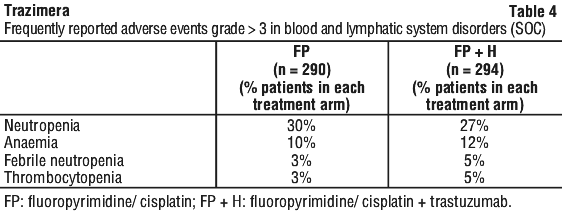 The total percentage of patients who experienced an adverse event of ≥ Grade 3 NCI CTCAE v3.0 categorized under this SOC were 38% in the FP arm and 40% in the FP + H arm.
 The HERA trial was designed to compare 1 and 2 years of 3-weekly trastuzumab treatment vs. observation in patients with HER2 positive breast cancer following surgery, established chemotherapy and radiotherapy (if applicable). In addition, a comparison of 2 years trastuzumab treatment vs. 1 year trastuzumab treatment was performed. Patients assigned to receive trastuzumab were given an initial loading dose of 8 mg/kg, followed by 6 mg/kg every 3 weeks for either 1 or 2 years. The efficacy results from the HERA trial are summarized in Table 6.
 The HERA trial included a subgroup of patients (n = 602) with small tumours (< 2 cm) and node-negative disease. In this subgroup, the relative risk reduction was similar to the overall trial population (HR = 0.50; 95% CI: 0.21 - 1.15). However, the benefit in terms of absolute difference in rate of recurrence after 1 year of follow-up was smaller (2.7% recurrence rate with trastuzumab vs. 5.5% with observation).
 The pre-planned final analysis of OS from the joint analysis of studies NSABP B-31 and NCCTG N9831 was performed when 707 deaths had occurred (median follow-up 8.3 years in the AC → P H group). At 8 years, the survival rate was estimated to be 86.9% in the AC → P H arm and 79.4% in the AC → P arm, an absolute benefit of 7.4% (95% CI: 4.9%, 10.0%. The final OS results from the joint analysis of studies NSABP B-31 and NCCTG N9831 are summarized in Table 8.
 The efficacy results from the BCIRG 006 are summarized in Tables 9 and 10.
 Based on studies to date, the optimal duration of adjuvant trastuzumab therapy is 1 year and may be clarified in further randomized trials. However, extending adjuvant treatment beyond 1 year is not recommended (see Section 4.2 Dose and Method of Administration).
 The addition of trastuzumab to neoadjuvant chemotherapy, followed by adjuvant trastuzumab for a total duration of 52 weeks, resulted in a 35% reduction in the risk of disease recurrence/progression. The hazard ratio translates into an absolute benefit, in terms of 3-year event-free survival rate estimates of 13 percentage points (65% vs. 52%) in favour of the trastuzumab arm.
 The relative overall survival advantage with the addition of trastuzumab was observed in both subgroups: AC [26.8 months (H + AC) vs. 22.8 months (AC-alone); p=0.052] and paclitaxel [22.1 months (H + P) vs. 18.4 months (P-alone); p=0.273] (also see Figures 1 and 2). The analysis of overall survival was, however, greatly confounded by subsequent trastuzumab treatment of each of control arms' patients, following disease progression, in the open-label extension study, H0659g (59% of patients in the AC-alone group, and 75% of patients in the paclitaxel-alone group subsequently received trastuzumab). Hence, the survival advantage seen above, for trastuzumab + chemotherapy treatment versus chemotherapy-alone (which includes patients who subsequently received trastuzumab) may underestimate the benefit to patients.
 Study M77001 was a multinational, multi-centre, randomized, controlled trial investigating the safety and efficacy of trastuzumab in combination with docetaxel, as first-line treatment in HER2 positive metastatic breast cancer patients. One hundred and eighty six patients received docetaxel (100 mg/m2 infused over 1 hour on Day 2) with or without trastuzumab (4 mg/kg loading dose, followed by 2 mg/kg weekly). Sixty percent of patients had received prior anthracycline based adjuvant chemotherapy. Trastuzumab with docetaxel was shown to be efficacious in patients whether or not they had received prior adjuvant anthracyclines and regardless of their oestrogen and/or progesterone receptor status.

 The clinical significance of the objective tumour responses in this group of patients was supported by the quality-of-life and survival data. Responders had clinically meaningful improvements in physical function, role function, social function, global quality of life and fatigue scale scores during trastuzumab treatment. Most responders were still alive at data cut-off (28/34; 82%). The Kaplan-Meier estimate of median survival for all treated patients at the data cut-off date was 12.8 months.