1 Name of Medicine
Water for Injections.
2 Qualitative and Quantitative Composition
Water for Injections Freeflex 100 mL, 250 mL, 500 mL or 1000 mL contains 100% v/v sterile water only.
3 Pharmaceutical Form
Injection, intravenous infusion.
Water for Injections Freeflex is a sterile, clear, colourless, particle-free, odourless and tasteless liquid with a pH of 5.6-7.7. It contains no anti-microbial agents.
4.1 Therapeutic Indications
Water for Injections is used to dissolve or dilute substances or preparations for parenteral administration.
Water for Injections may also be used as an irrigating solution for small wounds or during minor surgical procedures.
4.2 Dose and Method of Administration
For dissolving or diluting agents for parenteral administration.
The dosage for Water for Injections is that required to dissolve or dilute other agents. Aseptic technique must be used when preparing solutions for parenteral administration. Check the product information of any substance, preparation or drug before use to ensure appropriate solubility, dilution or compatibility with other additives.
Solutions prepared with Water for Injections may be administered intravenously, intramuscularly or subcutaneously using strict aseptic technique. Care should be exercised that all solutions prepared with Water for Injections are isotonic before use (see Section 4.4 Special Warnings and Precautions for Use). Water for Injections is to be used for one patient on one occasion only. Any residue should be discarded. It does not contain antimicrobials. Care should be taken with intravenous administration and injection technique to avoid injection site reactions and infections.
Usually solutions are prepared immediately before use. The product information of substances or drugs to be dissolved or diluted must be consulted to ascertain the maximum time between aseptic preparation and use of the solution.
For irrigation.
Before using Water for Injections to irrigate small wounds, or during minor surgical procedures, inspect the contents to ensure that there has been no discolouration. Water for Injections is a sterile product and when used for irrigation, strict aseptic technique should be observed at all times. Water for Injections is for use for a single patient on a single occasion. Any residue remaining should be discarded.4.3 Contraindications
Water for Injections is hypotonic causing haemolysis if it is injected alone. It is contraindicated for intravenous administration if it is not adjusted to isotonicity by the addition of suitable solutes.
The use of Water for Injection as irrigation during a major surgical procedure, or in a procedure where significant amounts may be absorbed or enter the circulation, is contraindicated.
4.4 Special Warnings and Precautions for Use
Do not use Water for Injections unless it is clear and the seal is intact.
Before dissolving or diluting any substance or preparation, consult the product information for the substance, drug or preparation to ensure that Water for Injections is the recommended solvent or diluent, check appropriate solubility, dilution or compatibility with other additives.
Ensure that the solution prepared with Water for Injections is isotonic with blood before intravenous administration. Entry of water or hypotonic solution into the systemic circulation may cause haemolysis. Given that there is a possibility of systemic absorption of irrigation solutions, the same precautions apply.
Tissue damage may result from irrigation with large volumes or under pressure. See Section 4.8 Adverse Effects (Undesirable Effects).
Use in the elderly.
No data available.
Paediatric use.
No data available.
Effects on laboratory tests.
No data available.4.5 Interactions with Other Medicines and Other Forms of Interactions
Not applicable.
4.6 Fertility, Pregnancy and Lactation
Effects on fertility.
No data available.
(Category A)
Check the product information document of the drug to be dissolved or diluted to ensure that it is safe to use during pregnancy.
Water for Injections can be administered to women who are breastfeeding. Check the product information document of the drug to be dissolved or diluted to ensure that it is safe to use during lactation.4.7 Effects on Ability to Drive and Use Machines
The effects of this medicine on a person's ability to drive and use machines were not assessed as part of its registration.
4.8 Adverse Effects (Undesirable Effects)
There should be no adverse reaction to Water for Injections if used as indicated to dissolve compatible substances to form an isotonic solution prior to injection. The product information of any drug or substance used with Water for Injections must be consulted before use.
Haemolysis and hyponatraemia have been reported after irrigation during urological procedure.
Injection of Water for Injections without the addition of solute may result in cell damage due to hypotonic effects. (See Section 4.4 Special Warnings and Precautions for Use; Section 4.9 Overdose). Haemolysis may lead to renal tubular obstruction. Expansion of intravascular fluid, through intravenous infusion, or systemic absorption of irrigation solutions, may result in electrolyte disturbances including hyponatraemia, and cardiovascular/ pulmonary disorders due to oedema.
Intravenous administration of solutions may cause local reactions including pain and vein irritation or other adverse reactions such fever, infection at the site of injection, venous thrombosis or phlebitis extending from the site of injection, extravasation, and hypervolemia. These may not necessarily be due to Water for Injections itself. Extravasation of solution may cause tissue injury.
Displaced catheters or drainage tubes can lead to irrigation or infiltration of unintended structures or cavities. Excessive volumes or pressure during irrigation of closed cavities may result in distension or disruption of tissues. Inadvertent contamination from careless techniques may transmit infection.
Reporting of suspected adverse reactions.
Reporting suspected adverse reactions after registration of the medicinal product is important. It allows continued monitoring of the benefit-risk balance of the medicinal product. Healthcare professionals are asked to report any suspected adverse reactions at www.tga.gov.au/reporting-problems.4.9 Overdose
If Water for Injections is inadvertently injected without first ensuring isotonicity, the hypotonic effects may include local cell damage or haemolysis.
Overdose using isotonic intravenous solutions prepared using Water for Injections or during irrigation, may cause fluid overload and electrolyte disturbances. See Section 4.8 Adverse Effects (Undesirable Effects).
Infusion or irrigation should be ceased and the patient assessed and treated appropriately.
For information on the management of overdose, contact the Poison Information Centre on 13 11 26 (Australia).
5 Pharmacological Properties
5.1 Pharmacodynamic Properties
Mechanism of action.
Water is the main constituent of the body fluids. Body weight is approximately 60% of water distributed in intracellular, interstitial and vascular compartments. The water content in the intracellular fluid, i.e. the water inside the cells, is about 40 to 45% of body weight. Water moves freely between these compartments. Thus, pharmacological action of the Water for Injection is as a vehicle for substances in maintaining the isotonicity across these compartments.
Clinical trials.
No data available.
5.2 Pharmacokinetic Properties
As Water for Injections is solute-free with osmolarity of zero (a hypotonic solution), its entry into the systemic circulation will result in a dilution of the electrolytes in the extracellular fluid leading to the movement of water into the red blood cells causing haemolysis. Thus, Water for Injections should not be injected without adjusting it to isotonicity by the addition of suitable solute.
5.3 Preclinical Safety Data
Genotoxicity.
Water is the main constituent of the body fluids and is not known as a mutagen.
Carcinogenicity.
Water is the main constituent of the body fluids and is not known as a carcinogen.6 Pharmaceutical Particulars
6.1 List of Excipients
Not applicable.
6.2 Incompatibilities
Incompatibilities were either not assessed or not identified as part of the registration of this medicine.
However, additives may be incompatible with Water for Injections Freeflex (see Section 4.2 Dose and Method of Administration; Section 4.4 Special Warnings and Precautions for Use).
Ensure appropriate solubility, dilution or compatibility with other additive and ascertain the maximum time between aseptic preparation and administration by consulting the Product Information of any substance, preparation or drug before use.
6.3 Shelf Life
In Australia, information on the shelf life can be found on the public summary of the Australian Register of Therapeutic Goods (ARTG). The expiry date can be found on the packaging.
6.4 Special Precautions for Storage
Store below 25°C.
6.5 Nature and Contents of Container
Water for Injections is supplied in freeflex bags - polyolefin.
Water for Injections Freeflex 100 mL AUST R 144795 - available in packs of 40, 50, 55 and 60 bags.
Water for Injections Freeflex 250 mL AUST R 144808 - available in packs of 20, 30, 35 and 40 bags.
Water for Injections Freeflex 500 mL AUST R 144809 - available in packs of 20 bags.
Water for Injections Freeflex 1000 mL AUST R 144814 - available in packs of 10 bags.
Not all pack sizes are marketed.
6.6 Special Precautions for Disposal
In Australia, any unused medicine or waste material should be disposed of in accordance with local requirements.
6.7 Physicochemical Properties
Chemical structure.
Chemical formula is H2O.
Molecular weight.
18.02.
CAS number.
The CAS number for water is 7732-18-5.7 Medicine Schedule (Poisons Standard)
Not scheduled.
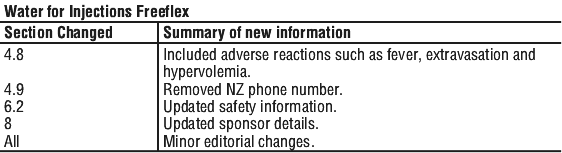
Summary Table of Changes